
Local SEO Checklist for Service Businesses (2026)
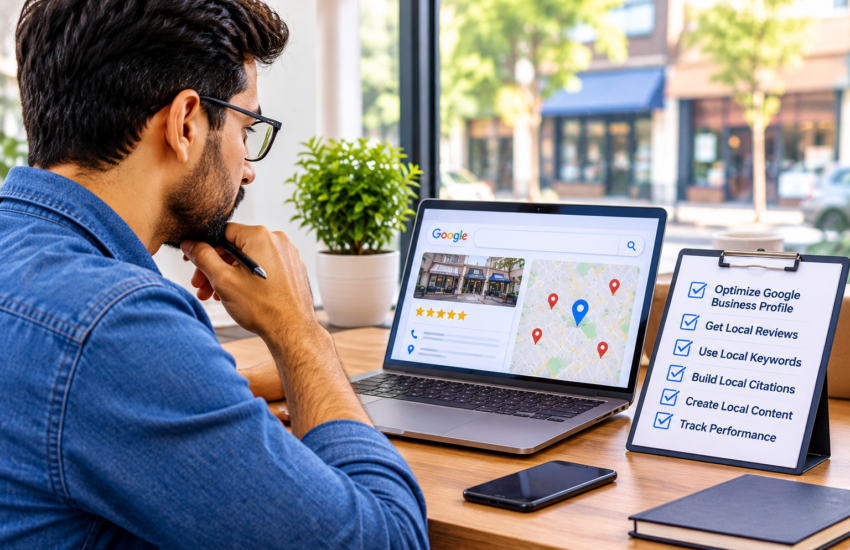
A local SEO checklist for service businesses comes down to five jobs: set up the right Google Business Profile, earn fresh reviews, build real service and location pages, keep your details consistent, and track the calls you win. Do them in that order.
Most checklists were written before Google retired Business Profile Q&A and before AI assistants became a local discovery channel. This one accounts for both. It also shows where effort pays off most, so you don’t lose a month on the wrong task.
- Profile type chosen correctly (address shown or hidden)
- Most specific primary category selected
- Real business name, no keywords added
- Hours accurate, holiday hours updated
- Services, description, photos and service areas filled in
- Review request sent after every job
- Every review answered within one or two days
- One page per core service, one page per area you truly serve
- Name, address and phone identical everywhere
- Local Business and Service schema added
- Calls, form leads, WhatsApp taps and website clicks tracked
- Mobile page loads fast
What Moves Local Rankings the Most?
Google says local results depend on relevance, distance and prominence. It doesn’t publish weights. Whitespark’s 2026 survey of 47 local SEO experts gives an informed estimate, not proof. It puts Google Business Profile signals at about 32% of local pack influence and reviews at about 20%. Citations sit in the single digits.
The strongest single factors were your primary category, distance to the searcher, keywords in the business name, an address in the city searched, and being open at the time of search.
That’s why the order below matters: profile first, reviews second, everything else in support.
1. Choose the Right Profile Type
If customers visit you, show your address. If they never do, Google’s guidelines say to hide it and list your service areas. If you have a showroom and also travel to jobs, you’re a hybrid.
There is a trade-off. Whitespark’s experts rate a visible address as a ranking factor, and a hidden-address profile can’t use it. Faking a storefront is not the fix. A suspended profile costs far more than any ranking gain.
Example: a cleaner working from a spare room should hide the address and list the cities served. A repair shop with a front counter can show it.
2. Build the Google Business Profile
Pick the primary category with care
Experts rank this as the strongest factor. Choose the most specific option, such as “roofing contractor” rather than “contractor”. Check what the top three local competitors use. Add secondary categories only for services you really provide.
Use your real business name
Keywords in the name are a strong signal, but Google’s guidelines ask you to represent your business accurately. Adding city or service words to your name invites suspension.
Keep hours accurate
Being open at search time entered the 2026 survey as a top-five factor. Set regular hours and update holiday hours before every holiday.
Fill in the rest
Add services with short descriptions, a plain-language business description, service areas, phone, website link, and real photos of jobs, your team and vehicles. Point the website link to the page that best matches the profile.
3. Earn Reviews on a Schedule
BrightLocal’s 2026 survey of 1,002 US adults shows how picky buyers have become. 74% look for reviews from the last three months. 31% will only use businesses rated 4.5 stars or higher. 19% expect a reply the same day. It’s US data, but the direction applies elsewhere.
What to do:
- Send the review link right after each finished job, by SMS, email or WhatsApp.
- Ask every customer, not only the happy ones.
- Reply to every review within a day or two. Stay calm with bad ones and offer to fix the problem offline.
- Never buy reviews or script keywords. Many countries ban fake reviews, such as the FTC rule in the US.
- Aim for a steady flow, not one burst.
4. Create Real Service and Location Pages
Your profile has limited space. Your website carries the proof.
One page per core service: Cover what’s included, how the job works, typical timelines, photos, reviews and a clear call button.
One page per area you truly serve: Add specifics: jobs done there, local rules, nearby landmarks, reviews from customers in that area.
No copy-and-paste city pages: Swapping only the town name creates doorway content, which Google’s spam policies target.
Link them together: Blog posts link to service pages, and service pages link to location pages. Our guide to internal linking for small business websites gives a simple plan.
Make contact easy on mobile: Put click-to-call at the top. Where customers prefer chat, add WhatsApp click-to-chat beside it.
5. Keep Your Details Consistent
Your business name, address and phone number (NAP) should match everywhere. Fix your website footer, contact page and profile first. Then claim the main directories in your country, plus Apple Business Connect and Bing Places, and add trade bodies and chambers of commerce. US checklists often name Yelp and the BBB. Elsewhere, pick the directories your customers actually use.
Citations carry less weight than older advice suggests. Fix errors and audit quarterly rather than chasing fifty listings.
6. Prepare for AI Answers
Industry reports say Google began phasing out Business Profile Q&A in late 2025 and replaced it with an AI-powered “Ask” feature in Maps. Answers draw on your profile, reviews and website. So advice to seed Q&A yourself is out of date.
AI matters for discovery too. In BrightLocal’s 2026 US survey, 45% of respondents had used ChatGPT or similar tools for local recommendations, up from 6% the year before. It is one survey, so treat the exact figure with care.
What to do:
- Answer real customer questions on your service pages: price ranges, response times, areas served, payment options, guarantees. State facts plainly.
- Add LocalBusiness and Service schema in JSON-LD, using the same facts as your profile. Schema helps machines read your details. It doesn't guarantee rich results or AI citations.
- Mention the service and area naturally when you reply to reviews.
- Ask Maps or an AI assistant questions about your business. If an answer is wrong, fix the page it likely came from.
7. Track Leads, Not Just Rankings
Rankings shift by device and location, so measure outcomes:
- Call tracking, form submissions and WhatsApp taps.
- The Performance view in your Business Profile: calls, website clicks and direction requests.
- UTM tags on your profile link, such as ?utm_source=google&utm_medium=organic&utm_campaign=gbp.
- A “How did you hear about us?” question at intake
Check speed too. Google’s good Largest Contentful Paint target is 2.5 seconds or less, measured at the 75th percentile. Our small business website audit checklist covers other fixes.
Five Common Mistakes
- Showing a home address on a service-area profile.
- Choosing a vague or wrong primary category.
- Stuffing keywords into the business name.
- Publishing city-swap pages.
- Chasing rankings without tracking calls.
Frequently Asked Questions
-
How long does local SEO take to work?
It depends on competition, profile age and your review base. Category and hours fixes can show sooner. Reviews and pages build over months. Treat any fixed promise with suspicion.
-
Do service businesses need a website for local SEO?
A profile can exist without one. But your website holds the service pages, FAQs and schema that support rankings and AI answers, and it gives customers more proof.
-
How many reviews do I need?
There is no official number. Compare yourself with the top three businesses in your local results, then match their rating.
-
Does hiding my address hurt rankings?
Experts treat a visible address as a ranking factor, so it can. But if customers don't visit you, Google's guidelines require you to hide it. Follow the rules and compete with reviews, categories and pages.
Start With These Three Fixes This Week
This week, fix your profile type, primary category and hours. Next, set up a review routine, then build service and location pages. Citations, schema and tracking follow. If you’d rather hand it over, see our SEO services and book a free consultation. For the wider plan, read our small business digital marketing plan.

